
5 Timeless Lessons Muslims Can Learn From The Odyssey

Ayman Farid
19 August 2026 4 min read

Adil Hussain
Head of Content
8 min read
Last updated on:
The question of whether to buy or rent a home is probably the most heated debate in our community right now. You’ll find fierce advocates on both sides, on social media, at dinner tables, in the group chat.
On one side, people say renting is dead money, that our community is already behind financially and needs home ownership to catch up. On the other side, people will remind you that the standard route to buying, just getting a mortgage, is haram for most Muslims. And the halal alternatives? They’re more expensive, less available, and surrounded by competing fatwas that leave most people more confused than when they started.
Across our team, we’ve done both. We’ve rented, and we’ve bought through a halal home finance product. And the honest answer is that it’s not as simple as either side makes it sound.
So this breaks the debate into two parts: the numbers, using a free calculator you can run for your own situation, and the harder question of the heart, the halal mortgage confusion, the competing fatwas, and the community pressure that surrounds all of it.
If you prefer to watch video, you can check out our video version of this article here.
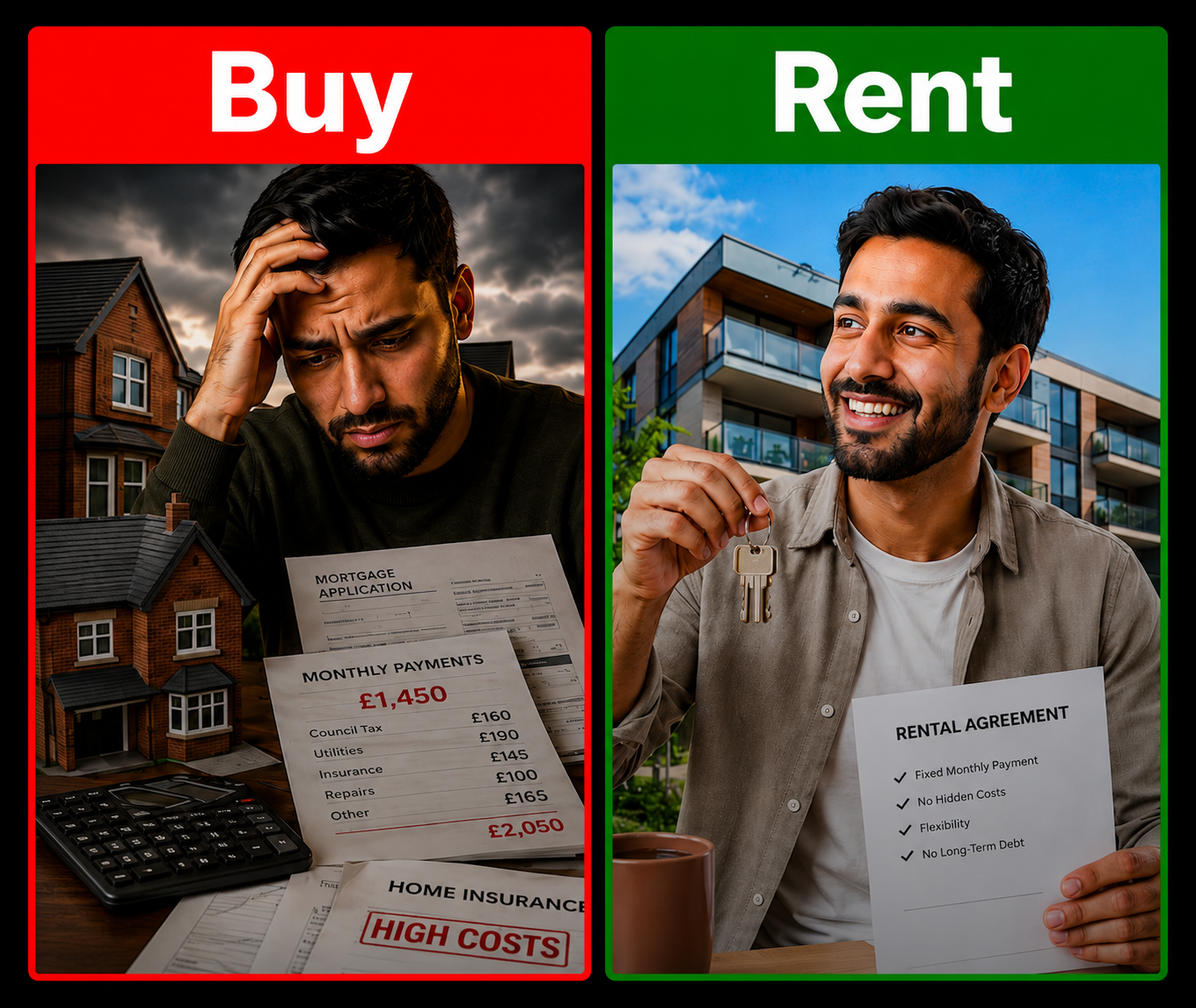
This is probably the most repeated line in the whole debate: that every month you pay rent, you’re throwing money away.
But think about it for a second. When you go out for dinner, you’re not throwing money away, you’re paying for a meal, a service, an experience. Rent works the same way. You’re paying for a roof over your head and for someone else to deal with the boiler when it breaks. That’s not dead money. That’s money spent on something you need.
Renting also saves you from significant upfront costs: no stamp duty, no legal fees, no maintenance bills landing out of nowhere. But what it really gives you is flexibility. If you need to move for work, you can. If you decide you’d rather live in a different country, even for a few years, it’s far easier to do that while renting. With a house that isn’t paid off yet, you’d need to figure out how to keep covering the payments while you’re away, which usually means becoming a landlord to tenants you’re managing from another country.
Pro-homeowners will point out that at least with a mortgage, you end up with a paid-off home after 30 years. That’s true, eventually. But it takes longer than most people think. In the early years, the bulk of your monthly payment isn’t building ownership at all. It’s mostly going toward interest, or in the case of an Islamic mortgage, rent on the share of the home you don’t yet own. Either way, equity builds far more slowly than most people realize.
So renting isn’t the straightforward financial mistake people make it out to be, and buying isn’t the obvious win people assume either. The truth sits somewhere in between, and it depends entirely on your numbers.
Most people make this decision by comparing just two numbers: their rent versus a mortgage payment. That comparison is almost always incomplete. What actually matters is the total cost of each option.
With buying, the costs stack up fast:
With renting, it’s simpler: your monthly rent, your utilities, maybe council tax. No stamp duty, no legal fees, no emergency repair fund, and your capital stays liquid.
Buying versus renting isn’t as simple as it’s made out to be, and the only way to know which makes sense for you is to actually run the numbers.
We built a free buy-versus-rent calculator that does exactly this. You enter your deposit, the property price, your expected mortgage or rental rate, your current rent, and the return you’d expect if you invested instead, and it calculates your break-even point, the moment buying starts to make more financial sense than renting.
Here’s how it plays out with a real example.
Take 28-year-old Adam from Birmingham. He works in finance, has lived at home, and has managed to save a £60,000 deposit. Well done, Adam. He’s found a decent starter home in Birmingham for £300,000 and is wondering whether he should rent instead.
His numbers:
The deciding factor is what Adam does with that £60,000 if it doesn’t go into a deposit:
So from a pure numbers perspective, if you can reliably invest your deposit at a rate that outstrips house price growth, you could end up better off renting.
But this isn’t the only consideration. Even if the numbers favour renting for your situation, that doesn’t automatically make renting the right answer. Stability, putting down roots, giving your kids a place to grow up, not being subject to a landlord’s decisions, these are real and valid reasons to buy. The numbers should inform your decision. They shouldn’t make it for you.
If buying is the right decision for you, the next question, especially as a Muslim, is how to do it the halal way. This is where the noise really starts: competing fatwas, strong opinions, and people on both sides speaking with more certainty than the situation deserves.
The mainstream conventional mortgage is interest-based, riba, and the prohibition on riba in Islam is serious. This isn’t a gray area in terms of principle. Where genuine debate exists is around necessity, context, and available alternatives.
In the UK, there’s a decent range of halal options. Providers like Gatehouse, StrideUp, and now Offa offer Home Purchase Plans (HPPs), regulated by the FCA and signed off by scholars. These typically operate on a diminishing musharakah model: a co-ownership structure where you buy a home together with the provider, pay rent on the portion you don’t yet own, and gradually buy them out. It can feel similar to a conventional mortgage on the surface, but the structure, risk, and tax treatment are genuinely different. There are also alternative providers worth knowing, including Pfida and Wayhome.
We’re supportive of these products and think they’re the right route if you can access them. But the honest caveat is that they’re currently more expensive than conventional mortgages, roughly 20% more in monthly payments in many cases.
That’s basic economics: these products serve a much smaller share of the market, meaning higher funding costs and a smaller client base. Scale brings prices down, but for niche products like these, the premium is currently a commercial reality.
The good news is that this is changing, and it’s something we’ve personally been working on. Closing that gap takes two things: more funding and more competition. T
hrough our GBP Income Fund, we’ve been funding providers like StrideUp and now Offa on their home purchase plans. More funding unlocks more capacity, and more competition helps drive rates down. We saw this play out directly when Offa launched their home finance products and came in below the market rate immediately. We expect that trend to continue.
To be honest, there will likely always be some premium, since these products serve a minority of the market rather than the majority. But the goal is to keep narrowing that gap as much as possible.
The first piece of advice: don’t reach for a blanket fatwa from the internet. Many rulings circulating online were written decades ago for a completely different context, and people apply them to their own situation without understanding what they were actually intended to cover.
Some of those same fatwas have even been used to justify entire buy-to-let portfolios on conventional mortgages, which was never their purpose.
Instead, speak to a local scholar who actually knows you: your income, your family situation, and what’s realistically available in your area. Fatwas are meant to be personal.
A scholar sitting with you and understanding your specific circumstances is in a completely different position to advise you than a generalized ruling issued for a different time and context.
Be honest with yourself in that conversation too. There’s a real difference between a halal product being genuinely inaccessible to you and it simply being more expensive than you’d like. Those are different situations, and a scholar can help you work out which one actually applies to you, and what the right next step is from there.
This debate gets thrown around on social media and at dinner tables by people on both sides who are well-intentioned but often working without the full picture. It’s genuinely nuanced, both numerically and spiritually, and that’s the whole point.
The most useful thing you can do next time this argument comes up, whether it’s in the group chat or at a family dinner, is run your own numbers through a proper calculator rather than relying on generic advice from either side.
Is renting really “dead money”? Not necessarily. Rent pays for housing, flexibility, and avoiding maintenance and upfront costs, similar to paying for any other service. Whether buying is financially better depends on your specific deposit, mortgage rate, and what return you could get by investing that deposit instead.
What’s the real cost of buying a home in the UK? Beyond the deposit (typically 15 to 20% of the purchase price), buyers should account for stamp duty, legal and survey fees (around £5,800 combined on average), ongoing maintenance (around £7,530 a year on average), and the opportunity cost of not investing the deposit elsewhere.
What are the main halal alternatives to a conventional mortgage? UK providers including Gatehouse, StrideUp, and Offa FCA-regulated, scholar-approved Home Purchase Plans based on a diminishing musharakah (co-ownership) model, though they currently carry a cost premium over conventional mortgages. There also alternative providers such as Pfida, Heylo Housing and Wayhome.
What should I do if I can’t afford a halal mortgage? Speak to a local scholar who understands your specific income, family situation, and local options, rather than relying on generalised fatwas that may have been written for a different context. There’s an important difference between a product being genuinely inaccessible versus simply more expensive than preferred.
Adil Hussain
Head of Content
Adil is currently the Head of Content for IslamicFinanceGuru with a long history of creating educational content for Muslims reaching millions. He holds a BSc in Mathematics, an MSc in Data Science and Analytics and a Diploma in Islamic Finance. Adil is currently the Head of Content for IslamicFinanceGuru with a long history of creating educational content for Muslims reaching millions. He holds a BSc in Mathematics, an MSc in Data Science and Analytics and a Diploma in Islamic Finance.

Leave a Reply