
5 Timeless Lessons Muslims Can Learn From The Odyssey

Ayman Farid
19 August 2026 4 min read
IW
IFG Staff Writers
8 min read
Last updated on:
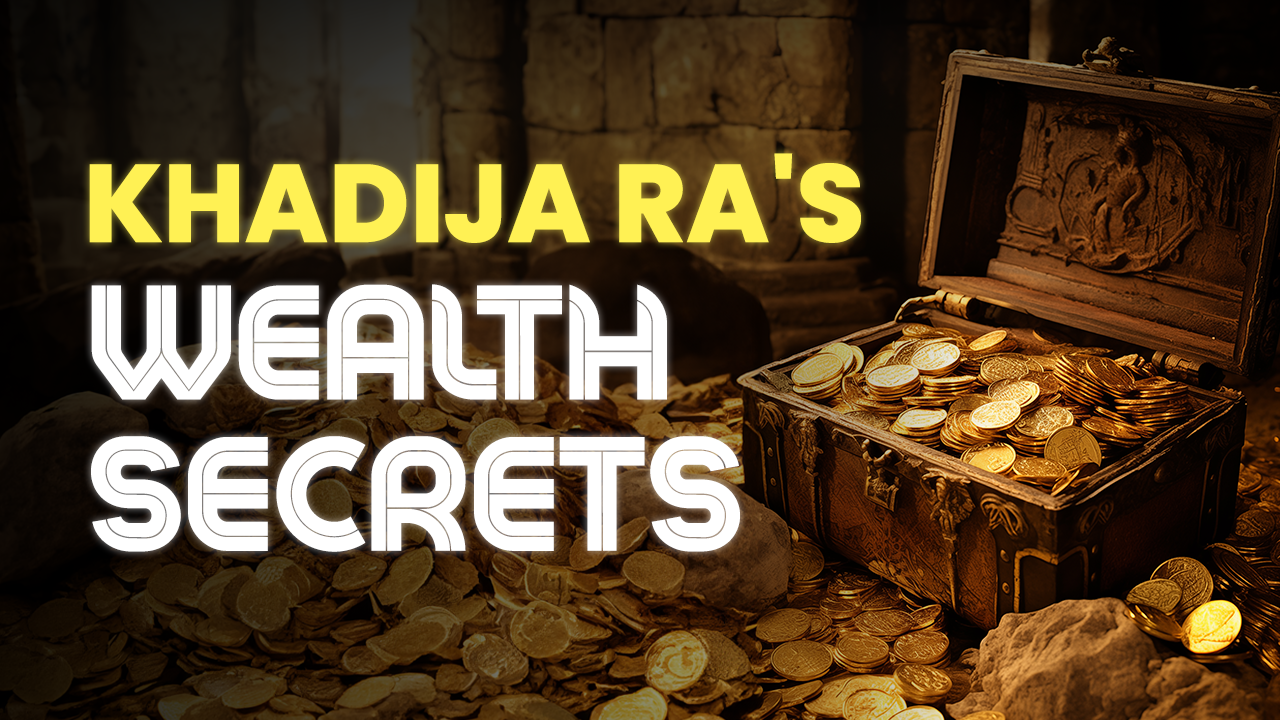
Khadijah RA is famously known as one of the four women promised paradise by the Prophet Muhammad ﷺ. But not many know the 6 wealth-building secrets that led her to be such a successful businesswoman whose commercial genius helped lay the foundation for Islam through supporting the Prophet Muhammad ﷺ.
In this article, we’re going to reveal these secrets because Khadijah RA wasn’t just a successful Muslim woman. She was also the wealthiest woman overall in Makkah and one of the most influential figures in the early days of Islam. Her business strategies and moral leadership made her a key figure in history. And her example provides us with timeless lessons for wealth creation and ethical business practices.
All insights here are drawn from authentic Islamic sources, including Sahih Al-Bukhari and Ibn Sa’d’s Kitab al-Tabaqat al Kathir, Ibn Hisham’s Seerah and other classical texts. And they say that you should always leave the best to last. So stick around for my favourite secret at the end of the article.
Khadijah RA was known for her impeccable judgment when selecting people to represent her business. In an age where business partnerships were often based solely on transactional value, Khadijah RA focused on character as the foremost trait.
When she needed someone to manage one of her most important trading expeditions to Syria, she didn’t select the most experienced trader. She selected Muhammad Ibn Abd’Allah ﷺ, a young man known for his honesty and trustworthiness but without any prior experience in trade itself. That decision to prioritise character over experience paid off exponentially. Muhammad ﷺ, with his unwavering integrity, doubled the expected profits.
Khadijah understood that in business, especially in long-distance trade, you can’t always oversee every single detail and micromanage employees. What you can control is who you trust. And this trust becomes a foundation upon which business was built.
In today’s business world, character should be a key factor when hiring or selecting business partners. Trustworthy relationships are the cornerstone of long-term success.
As the Prophet Muhammad ﷺ himself taught us in Sahih Bukhari:
“The best of you are those who have the best character” [Sahih al-Bukhari 6029]
In today’s world, the challenge of balancing a successful career with a fulfilling personal life is more difficult than ever. And yet Khadijah (RA) managed to do both impressively well. She not only ran one of the most successful businesses in Makkah, but she also maintained a strong, supportive relationship with the Prophet Muhammad ﷺ.
And despite her immense wealth and business commitments, Khadijah RA never let her career overshadow her role as a loving wife. Her relationship with the Prophet was one of mutual support and respect. Khadijah RA was the first person to believe in the Prophet Muhammad ﷺ when he received the first revelation. For example, when she heard that he’d been visited by an angel, her immediate response wasn’t to question him. It wasn’t to ridicule him. It was actually to take him to Waraka ibn Nawfal, a Christian scholar who confirmed the truth of the revelation.
She didn’t just support him financially. She became his emotional and spiritual rock during the most difficult moments of his life. It showed that a strong partnership at home allows for greater success in business and life. In today’s fast-paced world, this serves as a crucial lesson. We can achieve success in both professional and personal lives as long as we prioritise meaningful relationships, as both men and women.
As the Prophet Muhammad ﷺ said:
“The best of you are those who are best to their women”. [Sunan al-Tirmidhi, Hadith 1162].
Khadijah (RA)’s approach to business wasn’t limited to just hiring good people. She also rewarded them appropriately. She used a system of profit sharing known as Mudarabah, which is now a cornerstone of Islamic finance. In this model, rather than paying her agents a fixed salary, she would actually allow them to share in the profits of the venture. And this profit-sharing model aligned the interests of both parties and encouraged her agents to work harder and smarter.
Just like the example of the Prophet Muhammad ﷺ’s expedition to Syria, Khadijah RA understood that when businesses share risks and rewards, everyone involved has a personal stake in the success. And this model of Mudarabah didn’t just make good financial sense. It also fostered a strong bond of loyalty and hard work between her and her agents. The profit-sharing model that Khadijah RA implemented is just as relevant today as it was back then. It teaches us that when we share both the rewards and risks with people that we do business with, we build a sustainable business structure that pays people fairly.
Abd’Allah Ibn Umar reported that the Messenger of Allah ﷺ said:
“Pay the worker his wages before his sweat has dried” [Sunan Ibn Majah 2443].
In my opinion, this next wealth secret is quite underrated because not a lot of people appreciate just how well Khadijah RA managed risk in her business ventures by diversifying. She didn’t just place all her trust in one route or one product. Instead, she diversified her operation. She sent caravans to Syria, Yemen, and other profitable markets as well. This diversification helped her to minimise the risks that are typically associated with fluctuating market demands or the dangers posed by travelling through very hostile regions.
Additionally, she put in place strong systems of oversight. Trusted agents managed the day-to-day operations while supervisors like Misara monitored the performance of the expeditions. This dual oversight system ensured that Khadijah RA could mitigate risks without having to micromanage her business. And this kind of strategic risk management laid the foundation for long-term success. In today’s entrepreneurial world, diversification and effective oversight are absolutely crucial for managing risk and making sure that you can grow in a sustainable way.
As the Prophet Muhammad ﷺ famously said:
“Trust in Allah, but tie your camel first”.
A lot of the time, we make dua, but we don’t do much else. Our actions need to speak loudly as well.
In the days before contracts and legal systems, Khadijah RA understood that reputation was the most valuable currency that a business could possess. She didn’t just engage in trade. She built trust with her partners, her clients, and the broader community. Her reputation for fairness earned her the title, “Al-Tahira”, the pure one. And it was this reputation that opened doors for her.
In fact, the Prophet ﷺ valued her judgment so much that after her death, Anas Ibn Malik reported that when the Messenger of Allah ﷺ was given something, he would say, go to such person, for they were a friend of Khadijah RA. Go to the house of such a person, for they were loved by Khadijah RA.
To further emphasise what reputation she had, A’isha (may Allah be pleased with her) said:
“I never felt so jealous about any woman as I did for Khadijah RA. She had died 3 years before I married the Prophet Muhammad ﷺ. I heard him mentioning her so often, and his Lord ordered him to give her glad tidings of her palace in Paradise, made of reeds. The Prophet would slaughter a sheep and distribute its meat among her friends”.
[Sahih al-Bukhari 5658, Sahih Muslim 2435]
Today, reputation is still one of the most important assets that a business can have. In this world of social media and public scrutiny, reputation has never been more valuable. Not just for the sake of public perception, but as our responsibility as Muslims to be honest in our business dealings. As Allah says in the Quran:
“Indeed Allah commands you to render trusts to whom they are due”. [Quran 4:58]
Additionally, the Prophet Muhammad ﷺ said:
The honest and trustworthy merchants is with the Prophets, the truthful ones, and the martyrs”. [Sunan al-Tirmidhi, Hadith 1209]
This narration underscores the high value placed on honesty and trustworthiness, particularly in business. The Prophet elevates those who engage in trade with honesty to the highest ranks, equating them with the prophets and martyrs.
Khadijah RA didn’t just focus on profits. She invested in the community. She understood that wealth is not just about accumulation, but it’s also about creating impact. She used her wealth to support the Prophet Muhammad ﷺ’s mission. In Ibn Hisham’s Seerah, it is mentioned that when the Quraysh began their persecution of the early Muslims, Khadijah RA used her wealth to support the Prophet Muhammad ﷺ and the early Muslim community.
The boycott of the Muslims was a critical event during the early years of Islam, where the Quraysh imposed an economic and social blockade against the Prophet and his supporters. During this period, Khadijah and the Prophet were isolated in the Sh’ib Abi Talib (the valley of Abu Talib), a place of confinement where they faced severe shortages of food and supplies. The Muslims endured tremendous suffering, and Khadijah RA used her connections to provide whatever food, supplies, and assistance she could to the Muslims during this difficult time. Her commitment to the cause of Islam led to the community’s survival during this economic blockade.
She also invested in philanthropic efforts, knowing that by givin,g she was securing her place in the eyes of Allah. The famous verse in the Quran mentions:
“The example of those who spend their wealth in the way of Allah is like that of a grain of wheat which produces seven ears, with a hundred grains in each ear” [Quran 2:261]
Khadijah was rewarded for her efforts as demonstrated by this hadith – Abu Huraira reported that the Angel Gabriel came to the Prophet Muhammad ﷺ, and he said,
“Oh messenger of Allah, here is Khadijah RA coming to you with a dish of stew, food and drink. When she arrives before you, greet her with peace on behalf of her lord and myself. Give her glad tidings of a palace in paradise made of reeds wherein there will be no turbulence nor fatigue.” [Sahih al-Bukhari 3820] [Sahih Muslim 2432]
Khadijah RA’s story teaches us that true success in building wealth comes from integrity, character, and a higher purpose.
If you enjoyed reading this, consider subscribing to our newsletter and sharing this article with someone in your network.
If you want to learn more financial lessons from the Qur’an, you can download our free ebook containing 30 bite-sized lessons on how to manage your money in a way that pleases Allah here.
You may also be interested in reading our article on wealth secrets inspired by the life of Abdurrahman Ibn Awf (RA).
19 August 2026 4 min read


14 July 2026 8 min read
Tahir Khanzadah
10 months ago
MaShaaALLAH a very well composed article and a must read for all Muslims involved in businesses and trading.