Is SpaceX Halal or Haram to Invest In? A Muslim Investor’s Guide

Adil Hussain
Head of Content
9 min read
Last updated on:
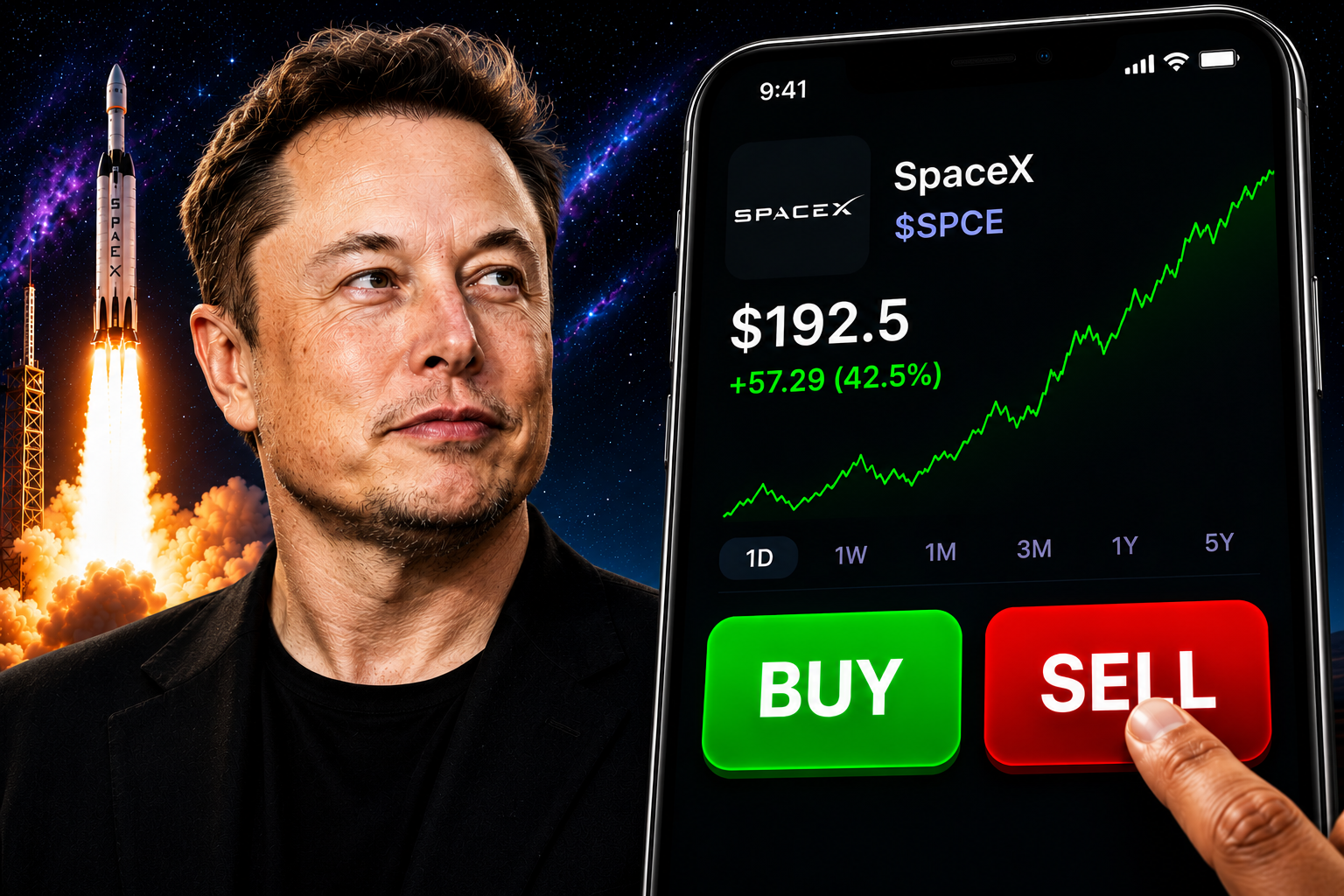
SpaceX, Elon Musk’s rocket company, has just been listed on the stock market for the first time and has already become one of the most valuable companies in the entire world with a valuation of ~2.5 trillion dollars.
For context, that’s bigger than the likes of Meta, Samsung and Walmart.
And lots of our readers have been getting in touch asking whether Muslims should be investing, so in this video we’re going to deep dive into SpaceX, look at what they actually do, and give our honest take on whether it’s halal and whether it’s actually a good investment.
What Does SpaceX Actually Do in 2026?
Before we get into either of those questions, we need to get clear on what SpaceX actually is in 2026, because most people think it’s just the rocket company when it is actually so much more.
Yes, it builds rockets.
The Falcon 9 launched more times last year than any other rocket on the planet combined, and Starship is being designed to take humans to Mars. NASA even handed SpaceX a $2.9 billion contract to get people back to the Moon. That side of the business is genuinely extraordinary.
But the rocket side of the business only accounted for 22% of SpaceX's revenue last year. The vast majority, 61% of it, comes from Starlink. Starlink is a satellite internet service that beams broadband to anywhere on earth and has over 10 million paying subscribers.
The remaining 17% comes from xAI, and this is the bit most people have missed. Earlier this year, SpaceX acquired Elon Musk’s AI company xAI in a deal that valued it at $250 billion. And xAI already owned X (formerly Twitter), having bought it the year before.
So when you buy SpaceX stock, you’re not just buying rockets. You’re buying Starlink, you’re buying Grok (Elon’s AI chatbot), you’re buying Twitter, all under one roof.
The cynic in us says that what Elon is doing is taking together a bunch of his companies, some that are profitable, some that are not so profitable, and perhaps individually would be hard to realise as much gain from, and bundling them all together into one mega mix that investors will look at and think:
‘actually, if I want access to the rockets or the Starlink bit of the business, I might as well buy into the whole thing.’
That way, people who invested in X when Elon Musk took over Twitter may well get a payout they’d otherwise struggle to get.
According to Elon via the pre-IPO S1 filings, the total addressable market across all of these different products, the rockets, the satellites, the AI, the social media, is $28.5 trillion.
For context, global GDP, the value of everything produced by every country on earth, is around $110 trillion. So Elon is saying he’s going to build something that could ultimately amount to about a quarter of the size of the entire world economy. Even for Elon, that’s a pretty big statement.
But that’s the pitch.
Does the SpaceX Valuation Actually Make Sense?
SpaceX launched at IPO with a $1.75 trillion valuation. At the time of writing, it’s now trading at almost $2.5 trillion.
And how much revenue are you getting for that valuation?
Well in 2025, SpaceX generated $18.7 billion in revenue.
That’s obviously very good money, but when you look at the price-to-sales ratio (how much you’re paying for every pound of revenue the company generated), it comes to around 130x.
To put that in perspective: the average S&P 500 company trades at around 3.6x its annual sales.
Meta and Alphabet, companies people already call expensive, trade at 7 to 12x. Palantir, which gets regularly described as overvalued, is around 64x.
And it’s not just us with the questions.
Morningstar, one of the world’s most respected independent investment research firms, put out a note ahead of the IPO saying SpaceX is significantly overvalued. At 130x versus Palantir at 67x, which was already considered massively overvalued, you can understand where they’re coming from.
According to Morningstar, SpaceX’s fair value is closer to $780 billion, roughly half the IPO price and now less than a third of their current valuation.
Their advice to retail investors is: wait. You’ll get a better entry point after the hype settles.
Why IPOs Are Often a Bad Deal for Retail Investors
This isn’t just a SpaceX problem. There’s a broader question here about IPOs in general.
By the way, if you’re not sure what an IPO is, IPO stands for Initial Public Offering, simply when a private company lists its shares on the stock market for the first time.
A lot of people hear IPO and think they’re getting in early. They’re not, really. The private investors who backed SpaceX years ago are the ones who got in early.
By the time it hits the stock market, many of these early investors have been waiting years to see a return, and this is their moment to cash out.
Warren Buffett himself once said: IPO stands for “it’s probably overpriced.”
Within the first day of listing, SpaceX shot up over 50%.
That isn’t surprising given SpaceX allocated 30% of the IPO to retail investors, three times the normal amount. The typical IPO reserves around 5 to 10% for everyday investors. SpaceX went to 30%. They were deliberately banking on Elon’s fanbase and the retail hype machine to drive the price up. And that kind of energy can send a stock flying into the stratosphere, at least for a while.
But here’s the thing: whether the stock is up 50% or 20%, it doesn’t change the underlying analysis. What goes up on hype and only hype tends to come back down once the fundamentals catch up. And the fundamentals here, as we’ve already walked through, are a very hard sell.
There’s also the lock-up period to think about. When a company lists, existing shareholders are typically locked in for around 180 days where they can’t sell. The moment that window opens up, we’ll all find out very quickly what the insiders actually think of the valuation. If they hold, that’s a vote of massive confidence. If they start selling aggressively, that tells you everything you need to know.
Is SpaceX Halal? Three Things Muslims Need to Consider
The money side is just one half of the equation for us as Muslims. There’s an even more important question: is it halal? With SpaceX, there are three things to work through.
1. Elon Musk’s Conduct
Ever since Elon Musk went from building rockets to building culture wars, a lot of people have had to ask themselves a difficult question about where they put their money. For Muslims, that question is even more pointed. Elon Musk has said things and platformed content that has caused genuine hurt and violence to our community and many other communities as well.
So should we in good conscience put money behind a company this man controls?
For context, Elon holds over 85% of the voting power at this company.
This is not a company where shareholders hold him accountable. What Elon wants, Elon gets.
Some of you will be able to separate the man from the business. But for many of us, it will be a push too far.
Boycotting products isn’t easily done, especially when they’re so pervasive and genuinely good products. But actively putting money behind him and his company, essentially underpinning his net worth, which is all tied up within this company, is possibly a step too far for many of us.
That’s a completely legitimate position to hold. And at this moment in time, that’s my position for my personal money.
2. Military Contracts and Weapons-Related Activity
According to SpaceX’s own S1 filing, the company provides the US military with national security space launches and space-based missile and aircraft tracking capabilities.
Let’s be specific about what that means in practice. SpaceX has a product called Starshield, a military version of Starlink built specifically for defence use. In May this year, the US Space Force awarded SpaceX a $2.29 billion contract to build the Pentagon’s next generation space communication backbone. It also holds contracts for missile warning and tracking satellites, and is expected to win the Golden Dome missile defence constellation contract, up to 600 satellites worth around $2 billion.
These aren’t just passive infrastructure contracts. According to Reuters investigations, Starshield terminals were used as the operational backbone for US military drone strikes during the war against Iran in 2025 and 2026, providing real-time video feeds and command guidance to attack drones.
Then there’s Israel. In 2023, Elon Musk personally agreed with the Israeli government that Starlink could operate in Gaza only with Israeli approval. A 2025 report by the Business and Human Rights Resource Center alleged Starlink’s involvement in IDF operations in occupied territories.
These are capabilities that have been used to target people in foreign countries. For the Muslim community in particular, that’s not something we can just scroll past.
3. X (Formerly Twitter) and Advertising Revenue
X’s primary revenue is advertising, which accounted for around $1.8 billion last year. A lot of those ads will inherently be promoting un-Islamic services, before we even get into the nature of the content on the platform itself. And remember, X isn’t a separate company anymore. It sits within SpaceX. When you buy the stock, you own a piece of that ad revenue as well.
Does SpaceX Pass the 5% Shariah Screening Rule?
To screen companies for Shariah compliance, scholars have developed a set of rules over the years, and one of the most widely used is the 5% rule. This states that no more than 5% of a company’s revenue should come from impermissible sources.
Let’s apply that to SpaceX. We should say upfront that this requires some assumptions, because SpaceX doesn’t cleanly break out every revenue line in a way that makes them straightforward to screen from a Shariah perspective. Like most other public company.
Starting with X: X generated around $1.8 billion in advertising revenue last year.
Not all advertising is impermissible, but a significant portion will be promoting financial products, alcohol, gambling, and other services that don’t pass a halal screen.
If we conservatively assume 25% of that advertising revenue is impermissible, that’s around $450 million, roughly 2.4% of SpaceX’s total revenue on its own.
Then there’s the military. SpaceX’s S1 discloses $5.9 billion in US government revenue in 2025.
Some of that is with NASA, civilian, but Starshield, the national security launches, and the missile tracking contracts are all genuinely military. We can’t clearly separate the figures, but even a conservative estimate puts purely military revenue at several percent of total revenue.
Add those together and you’re comfortably above the 5% threshold, before you even begin to account for the classified contracts that aren’t disclosed in the S1.
As it stands, SpaceX will either fail the screening based on the 5% rule alone, or sit firmly in ambiguous territory. Screening services like Zoya have also marked it as questionable, probably for these reasons.
These revenues could change, and therefore our analysis could change over time.
SpaceX could shed some of these impermissible revenue streams, lean further into space exploration, scale Starlink into something genuinely clean, and let the military and advertising pieces shrink into irrelevance as the business grows. That’s one path.
But it could just as easily go the other way, deeper military embedding, more advertising, more X. Nobody knows.
Our Verdict: Should Muslims Invest in SpaceX?
Right now, the financial case is already kind of difficult to make. The halal case is also kind of difficult to make. When you combine a valuation that independent analysts say is roughly double what the business is actually worth, with revenue streams that potentially breach the 5% haram rule, it’s very difficult to build a coherent argument for why a Muslim investor should be putting their money here right now.
Our advice: probably avoid SpaceX for now.
If you are on principle not someone who wants to support Elon Musk, then it doesn’t really matter what else follows. Don’t invest in SpaceX.
If you can get over that hurdle, on the basis that the companies and products Elon has put into the world are so widespread that no one can really avoid them, similar to Microsoft, Google, or Amazon, and therefore we might allow ourselves to invest in them, you still need to get comfortable that 95% or more of all SpaceX revenue is actually halal. And that isn’t clear cut, as we’ve just discussed.
So even if you’re in this latter camp, we’d probably sit on the fence until there’s a little more clarity on revenue, and until the valuation comes down to something more sensible.
Those are our thoughts. We’d like to hear from you. What do you think? And let us know if you’d like us to cover any other stocks in the market. We’ll happily dive into those.
Adil Hussain
Head of Content
Adil is currently the Head of Content for IslamicFinanceGuru with a long history of creating educational content for Muslims reaching millions. He holds a BSc in Mathematics, an MSc in Data Science and Analytics and a Diploma in Islamic Finance. Adil is currently the Head of Content for IslamicFinanceGuru with a long history of creating educational content for Muslims reaching millions. He holds a BSc in Mathematics, an MSc in Data Science and Analytics and a Diploma in Islamic Finance.


Leave a Reply