
Our Community Needs to Start Financing Its Own Future
Zain Karbani
15 July 2026 6 min read
Adil Hussain
Head of Content
7 min read
Last updated on:
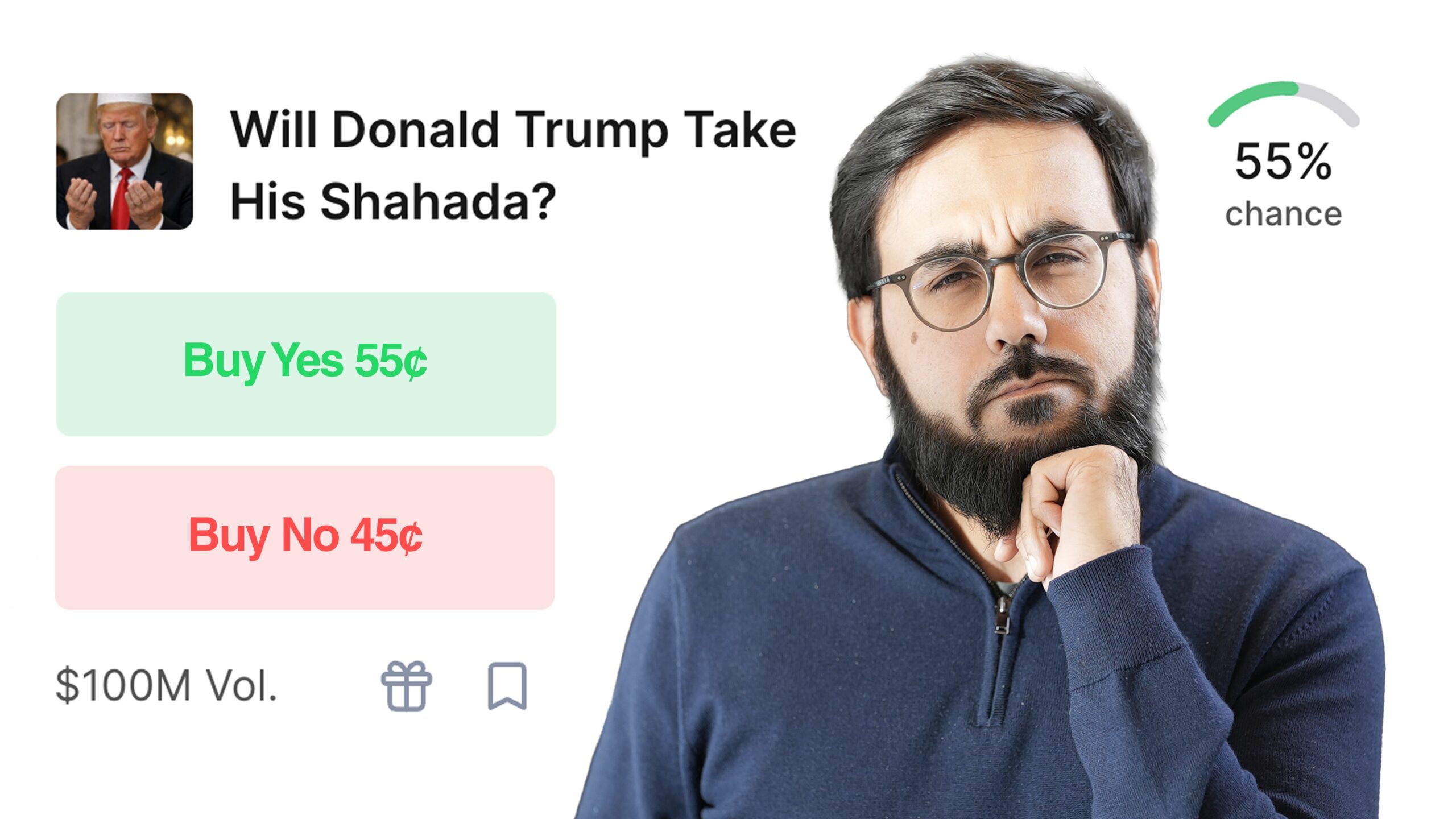
Prediction markets like Polymarket and Kalshi have exploded in popularity, with billions of dollars flowing through these platforms. Young people are making money betting on everything from Bitcoin prices to political outcomes. But as Muslims, we need to ask a more important question: is this actually halal, or just gambling with better branding?
We have recorded a YouTube version of this article, if you’d prefer to watch instead. Just click here.
A prediction market is basically a market for yes-or-no outcomes. You’re not buying a company, you’re not owning an asset like gold or property – you’re taking a position on whether something happens or it doesn’t.
Here’s how it works in practice.
Let’s say there’s a market that asks: “Will Bitcoin hit $200,000 by the end of the year?”
That market has two sides: Yes and No.
Each side trades between $0 and $1.
If the market thinks there’s a 70% chance this happens, the “Yes” side might trade at $0.70.
Now, if you think the market has got it wrong – if you believe the real probability is higher than what’s being priced in – you buy.
If new information comes out and the price moves up, you don’t have to wait until the end. You can sell your “Yes” share immediately for a profit. Prices constantly move based on trading activity, with algorithms adjusting them based on supply and demand.
But if you do hold until the market resolves, the ending is simple.
If Bitcoin hits $200,000, your contract settles at $1 and you make 30 cents per profit per share. If it doesn’t – it settles at $0 and you lose what you put in.
That’s the entire trade.
A key question that’s been debated from all sides is whether this is actually gambling – or whether it’s a form of trading.
State gambling regulators and attorneys general in the US have issued cease-and-desist orders arguing these contracts are essentially unlicensed bets, falling under state gambling law rather than financial regulation.
Major sports leagues, like the NFL and the PGA Tour, ban players from using these platforms. They treat prediction markets as equivalent to sports betting, warning about corruption and match-fixing risks.
A lot of journalists and academics make a similar point. They say this is zero-sum – for someone to win, someone else has to lose – and that it encourages speculation and addictive behaviour.
The platforms themselves, like Kalshi and Polymarket, argue these are financial contracts, not bets. That’s why they try to operate under regulators like the Commodity Futures Trading Commission.
Vlad Tenev, the founder of Robinhood, has described prediction markets as “truth machines.” He pointed to how, during the US presidential election, prediction markets were calling the outcome more accurately – and often earlier – than polls and even major news outlets.
His point was that when real money is on the line, people are forced to be honest. Prices update instantly as new information comes in, which can make these markets very good at cutting through noise and hype.
Supporters also argue this can be used to manage risk, similar to how businesses already use futures. For example, a company that depends on oil might buy a contract that pays out if oil prices rise. If prices spike, the payout helps offset higher costs. If they don’t, the business benefits anyway.
So depending on who you ask, this is either gambling with a new coat of paint – or just another kind of financial market.
When you strip this back, it’s actually pretty plain. You don’t own anything – you’re just putting money down on whether something happens or not.
If it looks like gambling, sounds like gambling, and works like gambling… it’s probably gambling.
That’s also how scholars analyse it structurally.
Mufti Bilal Omarjee, for example, explains that prediction markets fall under mughalabat – situations where money is staked on an uncertain outcome, and the loser pays the winner without receiving any real counter-value.
There’s no asset being owned, no service provided, no productive activity underneath it – just a zero-sum transfer of wealth tied to uncertainty. And that’s the kind of structure Islamic law classifies as gambling.
What’s interesting is that the Qur’an itself recognises why people are drawn to this.
“They ask you ˹O Prophet˺ about intoxicants and gambling. Say, ‘There is great evil in both, as well as some benefit for people—but the evil outweighs the benefit.'” (2:219)
As the verse says, gambling has some benefit for people, but that its harm is greater than its benefit.
And that’s exactly the point.
Of course it can be fun. Of course it’s exciting. And yes, you might even make a lot of money very quickly, without much effort. That’s why people are drawn to it.
But when you zoom out, the damage is obvious. These platforms only survive because, over time, most people lose. The house has to win, otherwise the business doesn’t exist.
And the consequences aren’t just financial. Gambling is tied to addiction, anxiety, depression, people losing savings, relationships breaking down, and families being affected. That’s not theoretical — it’s well-documented.
So Islam isn’t blind to the upside. It’s saying that when something consistently causes that level of harm, no amount of excitement or occasional wins makes it worth it.
And that’s why, when scholars apply this lens to modern versions of gambling – including prediction markets – the conclusion is clear: they are haram.
There is one rather obvious way to do it. Instead of betting on an outcome, you look for the real-world consequences of that outcome and invest there.
If you think Bitcoin is going to $200,000, you don’t need to bet on the price – you can just literally buy Bitcoin.
And likewise if you think the price of something you already own is going to fall, you sell it.
Folks, that’s what plain old-fashioned investing actually is.
You form a view about what’s going to happen, and then you buy or sell real assets that you believe can capture that value.
It’s not as exciting and not as easy which brings me to a bigger problem.
The really concerning thing here isn’t just prediction markets. It’s why so many young people are being pushed toward these high-risk, all-or-nothing opportunities in the first place.
Because look around.
Wages haven’t kept up with inflation. Housing feels completely out of reach. Food is expensive. Everything is expensive. And by the end of the month, most people barely have anything left after bills.
On top of that, people are worried about AI taking jobs, careers becoming unstable, and the idea of “work for 40 years, save a bit every month, retire comfortably” just doesn’t feel realistic anymore.
So when you go online and see people younger than you becoming millionaires through things like crypto or forex, of course it pulls you in.
You think: if they can do it, why not me? AI is going to destroy my future anyway.
And for a lot of people, that starts to feel more realistic than slowly building wealth over decades in a system that already feels stacked against you.
When the normal path feels broken, shortcuts start to feel like the only option.
But the sad truth is for most of us, there aren’t any real shortcuts.
Yes, there are paths where people can make a lot of money in a relatively short time – such as starting a business or marrying into the right family (wink). But these paths usually involves an extreme amount of work, the right ideas, the right environment, and the right timing – and even then, it’s rare.
You can improve your odds. You can put yourself in better rooms, learn faster, and take more calculated risks. But it’s still hard, and it’s still unlikely.
There’s another route that’s far more achievable for most people. That’s the high-paid skills route.
Getting paid well for valuable work. Living within your means. And investing consistently.
Because investing in the right assets can actually speed the process up. You’re not just leaving money to rot in a bank account, and you’re not losing it chasing high-risk bets either.
There are options across the spectrum.
If you want something simple, things like gold or even silver – gold, for example, has roughly doubled over the last couple of years.
If you don’t want volatility and you want something steadier, there are income-style investments that pay you a predictable return each year – slower, but far more stable. Such as our GBP income fund which pays 7.5% every year.
And if you are willing to take more risk, you can do that without gambling – by investing in real businesses. Startups, or more established companies with actual cashflows behind them. Or things like pharmacies, for example, which is something we’re doing with our private equity strategy.
At the start, it feels slow. The numbers look small. But over five or ten years, it compounds into something meaningful.
There’s also one more option that’s worth mentioning – especially for younger people. Starting your own company.
And right now, with AI, there is a bit of a gold rush. There’s a lot of uncertainty, but if you’ve got time, energy, and you’re digitally savvy, building something people actually like and are willing to pay for might be one of the best bets you can take.
You don’t need much money – you need curiosity, speed, and a willingness to experiment. Vibe-code things, ship fast, learn quickly. Most won’t work, but some will.
And honestly, this idea of getting rich really young and never working again – how many people actually want that?
It sounds nice, but it gets boring. Most people want purpose. They want something to build. They want work they don’t hate.
The better goal is to enjoy the journey. Find work you care about. Work hard. Make small improvements year after year.
Remember for us, this life isn’t the finish line. It’s a stepping stone and if we play our cards right, then the reward will be far greater than any 1000x moonshot on a random crypto coin or a Polymarket bet.
Adil Hussain
Head of Content
Adil is currently the Head of Content for IslamicFinanceGuru with a long history of creating educational content for Muslims reaching millions. He holds a BSc in Mathematics, an MSc in Data Science and Analytics and a Diploma in Islamic Finance. Adil is currently the Head of Content for IslamicFinanceGuru with a long history of creating educational content for Muslims reaching millions. He holds a BSc in Mathematics, an MSc in Data Science and Analytics and a Diploma in Islamic Finance.
15 July 2026 6 min read
24 July 2025 15 min read

Leave a Reply