Why Muslims Will Suffer Most When The AI Bubble Bursts
Adil Hussain
Head of Content
7 min read
Last updated on:
In the late 90s, everyone was piling into internet companies. The stock market was booming, and it felt like free money. Then in 2000, it imploded. Companies worth billions became worthless almost overnight, and an estimated 100 million everyday investors lost a combined $5 trillion.
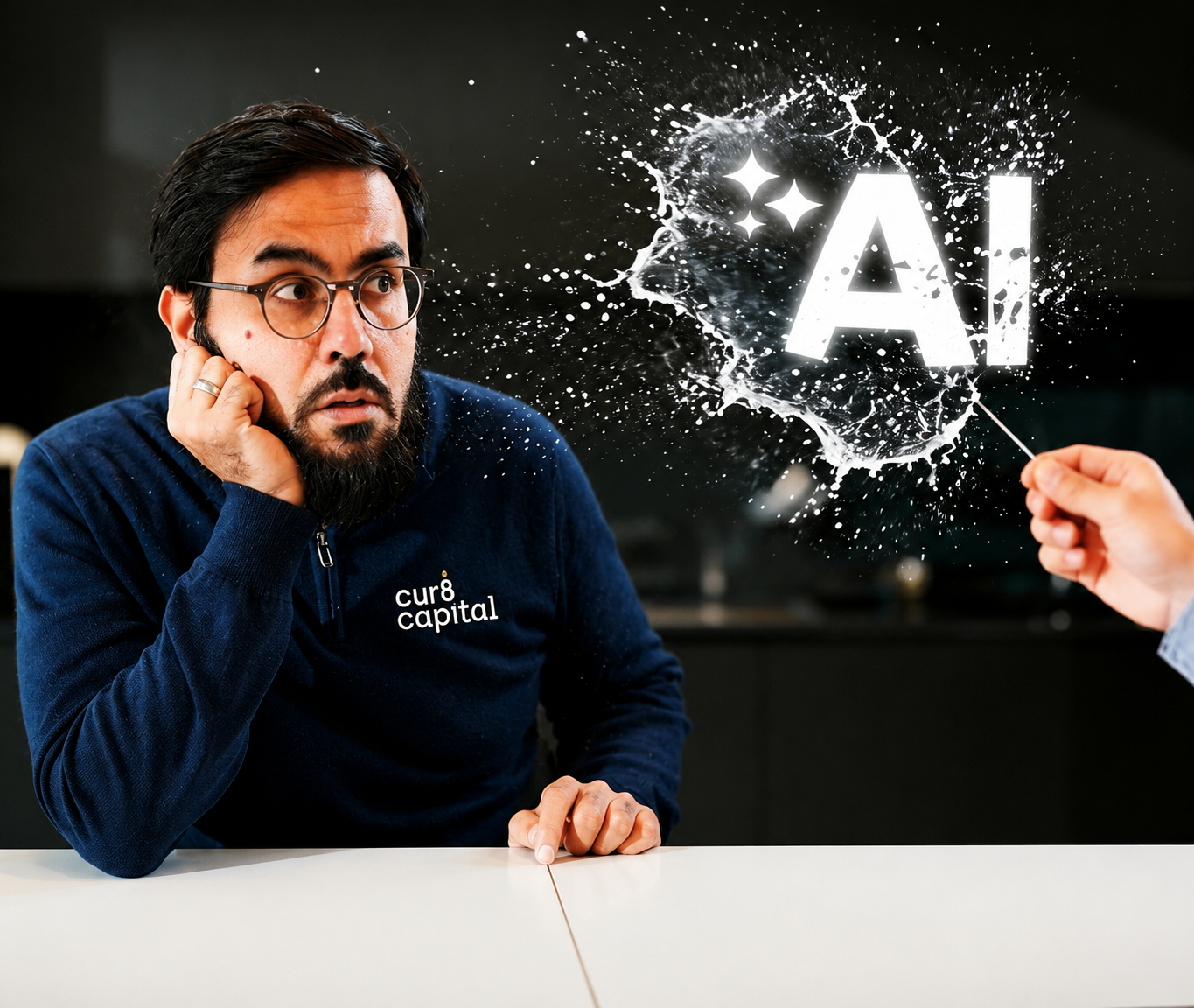
Now people are worried AI could be the next bubble. And if they’re right, Muslim investors could be hit the hardest, even though most of us don’t realize it yet.
Here’s why, and what every Muslim investor should be doing right now to prepare.
(If you’d prefer to watch the video version of this article, click here).
The AI Boom
Over the past few years, the stock market has been on an absolute tear, and almost all of it has been driven by a handful of companies: the Magnificent Seven, Microsoft, Apple, Nvidia, Amazon, Meta, Alphabet, and Tesla. All making big bets on AI.
Share prices going up isn’t itself a problem. What makes people nervous is the valuation. Take Nvidia. It’s now one of the largest companies in the world, and investors are giving it a price-to-earnings ratio of around 50. That means at current earnings, it would take 50 years of profits to earn back what you paid for the stock today. That’s an enormous amount of faith in future growth.
That faith might well be justified. These companies are genuinely transforming industries. But history tells us that when the story gets ahead of the fundamentals, eventually something snaps. We’re not saying it will, but it’s worth asking: what’s the most fragile part of this whole thing? What’s the single point of failure? Because there is one.
The One Company Risk
Most people think Nvidia makes AI chips, but that’s not quite accurate. Nvidia designs chips. The company that actually manufactures them, along with Apple’s chips and pretty much every other cutting-edge processor you can name, is one company: TSMC, Taiwan Semiconductor Manufacturing Company.
In 2025, TSMC held nearly 70% of the global foundry market. Its nearest competitor sat at just over 7%. This isn’t market dominance, it’s near-total control of the most critical technology in the world right now.
And TSMC is based in Taiwan, an island that China considers its own territory. Zoom out for a second and the world right now is not a stable place. As of mid-2026, the Strait of Hormuz, a critical route for the oil and gas supply chains that feed into chip manufacturing, has faced repeated closures and disruptions amid the escalating conflict between Iran, Israel, and the US. We are living through a period of genuine geopolitical instability in a way we haven’t seen in decades, and there’s a very real chance that something could happen that disrupts TSMC directly.
You might ask: couldn’t Nvidia just use another manufacturer if something happened to TSMC? Unfortunately, this is almost impossible. The chips powering modern AI can only be manufactured by two companies in the world, TSMC and Samsung. Samsung is theoretically the backup, but Nvidia actually tried them during the pandemic and went straight back to TSMC because the defect rates were too high.
TSMC is building new factories in Arizona, but the project is already years behind schedule, and building the talent and supply chains needed is a decade-long project at minimum. There simply isn’t a feasible plan B today. So if something happens in Taiwan, the entire AI industry is in serious trouble.
Why Muslims Are More Exposed Than Most
This is the part nobody is talking about.
Most conventional investors have a naturally diversified portfolio. They’ve got the S&P 500, which spreads money across 500-plus companies spanning every major sector of the US economy, plus often some exposure to bonds on top.
As Muslims, we can’t just invest in anything. Shariah screening excludes companies involved in haram activities: conventional banking, alcohol, gambling, tobacco, weapons. All out. In practice, that means our version of the S&P 500 looks very different to everyone else’s. A standard S&P 500 ETF has around 35% allocated to tech. But the most popular halal alternative, SPUS, sits at around 55% tech exposure, because once you strip out those haram industries, what’s largely left is tech.
Within that, SPUS’s three biggest holdings alone, Apple, Nvidia, and Microsoft, make up around 37% of the entire fund. Yes, Nvidia again, the company sitting right at the center of everything above.
To be fair, this concentration has actually worked in our favor recently. These ETFs have outperformed the S&P 500 over the past few years, largely because tech has done so well. But that sword cuts both ways. If tech crashes, so will your portfolio.
Compare that to a conventional investor who can spread their money across banks, insurance, defense contractors, and bonds, sectors we can’t touch. If tech takes a hit, those other sectors typically cushion the blow for them. We do have sukuk as a halal alternative to bonds, but let’s be honest, most Muslim investors aren’t holding them. We’re mainly just in stocks, so when stocks fall, there’s very little else in our portfolios to soften the blow.
You might be thinking you’re not that exposed to stocks. But if you have a pension or a workplace retirement account, you almost certainly are, since most of those are by default heavily invested in equities. This affects more of us than we realize.
So if the AI bubble does burst, or something happens in Taiwan, Muslim investors will feel it harder and faster than most.
What Should You Do?
There are really just two takeaways here.
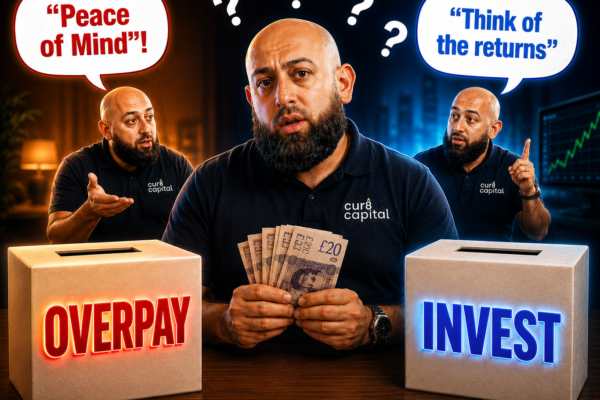
First, acknowledge the concentration risk. Most Muslim investors have never looked at their halal ETF and thought “over half of this is in tech, and over a third of it is in three companies.” Now you know. That’s not a reason to panic or sell everything, but it is a reason to be intentional. If you’re comfortable being heavily in tech, believe in the AI story, and are willing to ride out the bumps, that’s a valid position. But if you’ve just realized your portfolio is more exposed than you thought, the second point matters.
Second, diversify properly. But let’s be specific about what that actually means, because diversification isn’t just buying a different halal ETF.
True diversification means holding assets that are uncorrelated, in plain English, assets that don’t all fall at the same time for the same reason. If everything in your portfolio moves up and down together, you’re not really diversified, you’re just spread across the same risk.
So what does that look like in practice?
Gold and silver are the classic example. When markets are turbulent and investors are nervous, gold tends to hold its value or even go up. It zigs when stocks zag.
Property is another. Most Muslims already have a love affair with property, and for good reason. But you don’t have to wait until you’ve saved a full deposit to get exposure. There are now platforms where you can invest in property for as little as £100. Our own GBP Income Fund gives you pooled exposure to property, funding halal home finance providers like StrideUp and Offa as they help Muslims get onto the property ladder, and you can get started from as little as £5,000.
Businesses outside the stock market entirely are a third route. On the early-stage side there’s startup investing, high risk, high potential reward. Then there’s private equity, investing in established, profitable businesses looking to grow. We run our own halal private equity strategy investing in a chain of pharmacies across the North of England, real businesses generating over £30 million in annual revenue, completely uncorrelated to what’s happening on the Nasdaq.
The point is simple: spread your eggs across different baskets, not just different stocks, but different types of assets and different geographies altogether, so no single event, whether that’s an AI bubble, a crisis in Taiwan, or conflict in the Middle East, can put everything you’ve built at risk.
The Bottom Line
The AI story might well keep running for years. But if you’re a Muslim investor and most of your portfolio sits in a halal ETF, there’s a good chance you’re more concentrated in tech, and specifically in Nvidia, than you realized. That’s not a reason to panic. It’s a reason to look at what you actually hold and decide, deliberately, whether that level of concentration is one you’re comfortable with.
Frequently Asked Questions
Why are Muslim investors more exposed to an AI bubble than other investors? Shariah screening excludes sectors like banking, alcohol, and defense, which leaves halal index funds more concentrated in tech than conventional equivalents. The most popular halal alternative to the S&P 500, SPUS, holds around 55% tech exposure compared to roughly 35% for the standard index.
What is the TSMC risk mentioned in AI bubble discussions? TSMC manufactures nearly 70% of the world’s advanced chips, including those designed by Nvidia and Apple, and is based in Taiwan. Given regional geopolitical tensions and TSMC’s near-total control of advanced chip manufacturing, any disruption there would have an outsized effect on AI-driven markets.
How can Muslim investors diversify a halal portfolio beyond tech-heavy ETFs? Options include gold and silver, property investment through pooled funds, sukuk, and private market investments like halal private equity or startup investing, which are less correlated with public tech stocks.
Should I sell my halal ETF because of AI bubble risk? Not necessarily. Understanding your concentration risk is about being intentional rather than panicking. Some investors may be comfortable staying heavily weighted in tech, while others may choose to diversify into other asset classes.
Adil Hussain
Head of Content
Adil is currently the Head of Content for IslamicFinanceGuru with a long history of creating educational content for Muslims reaching millions. He holds a BSc in Mathematics, an MSc in Data Science and Analytics and a Diploma in Islamic Finance. Adil is currently the Head of Content for IslamicFinanceGuru with a long history of creating educational content for Muslims reaching millions. He holds a BSc in Mathematics, an MSc in Data Science and Analytics and a Diploma in Islamic Finance.
Leave a Reply